
A Life in Comics 8: TOUGH ON THE STREETS
“Where do you get your ideas from?“
“How did you come up with Judge Dredd?”
“Why are you banging your head against the wall?”
Because I’ve been asked the first two questions so often just about anything is preferable to having to reply to them again. To the first I’m often tempted to say “Oh, I just steal them from other writers” – which as I’ve explained in an earlier chapter has a grain of truth in it, as we all feed off each other. But it’s hardly a proper answer.
So okay – I’ll deal with that one in a later segment, should I survive that long, entitled ‘Putting a Story Together’, in which I’ll demonstrate how all the rules on story construction that I once took as gospel can be safely disregarded. The second question I’ll tackle now on the understanding that in future, when asked, I need simply reply ‘read A Life in Comics part 8.’ Alternatively ‘read the book’. Better still ‘BUY the book. Why, I have one here. Only £20. But to you, £19.99.’
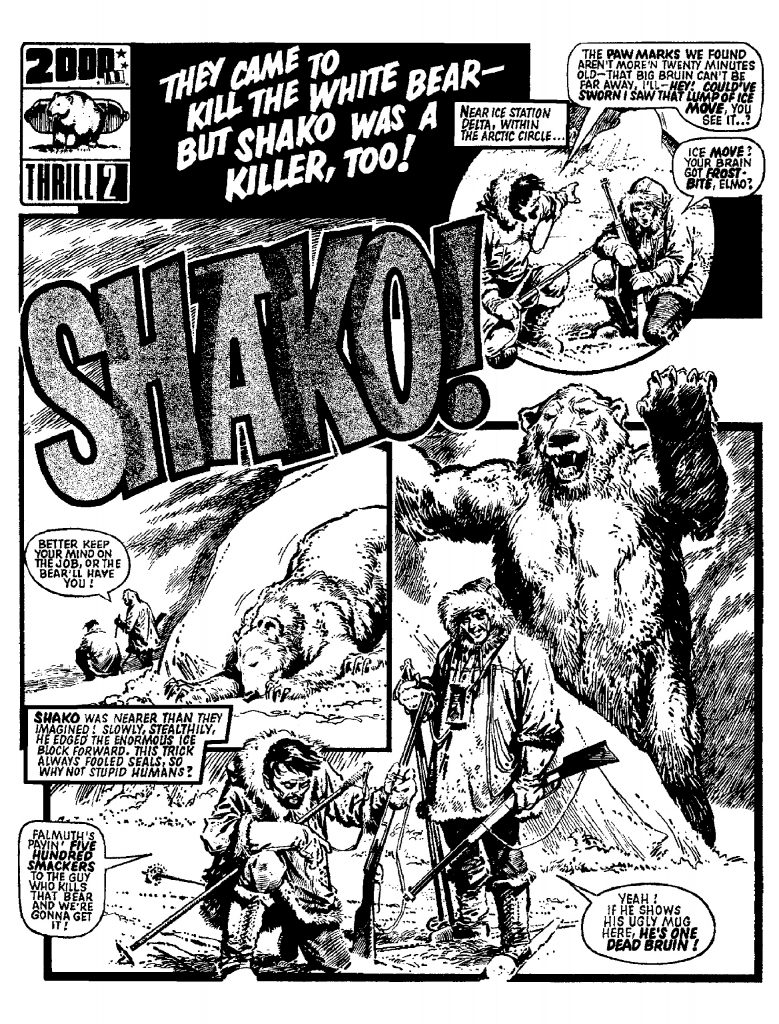
So where are we? Looking back through my ancient workbook I see among entries for Shako and Dredger, Darkie’s Mob and ‘Editorial Work’, the legend Judge Dredd 1 (actually the name is written as ‘Dread’, like the reggae artist from whom it was borrowed). The date is 21 July, 1976. Payment of £53 is made on August 31.
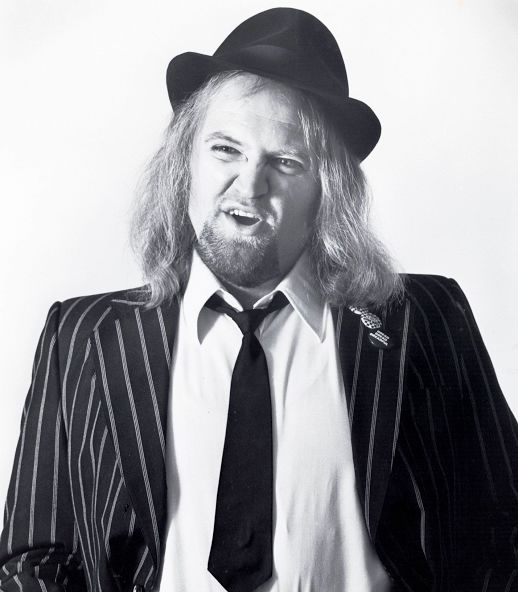
Years later, when we freelances have managed to obtain a basic royalties deal, I will find myself in receipt of small payments for scripts I have no memory of having written, among them some for Dredger and Shako. This puzzles me until I remember that it was Pat Mills’ way of paying me for assistance on the new science fiction comic he’d been tasked with producing; either there was no budget allocation for another person or none for me in particular – I can no longer remember which – but Pat would write scripts for certain stories and put payment through in my name to compensate me for my time. I have come aboard to critique script and story ideas and contribute some of my own, though by the time I join Pat he is well on the way to having what comes to be called 2000AD in the can, albeit with a few rough edges.
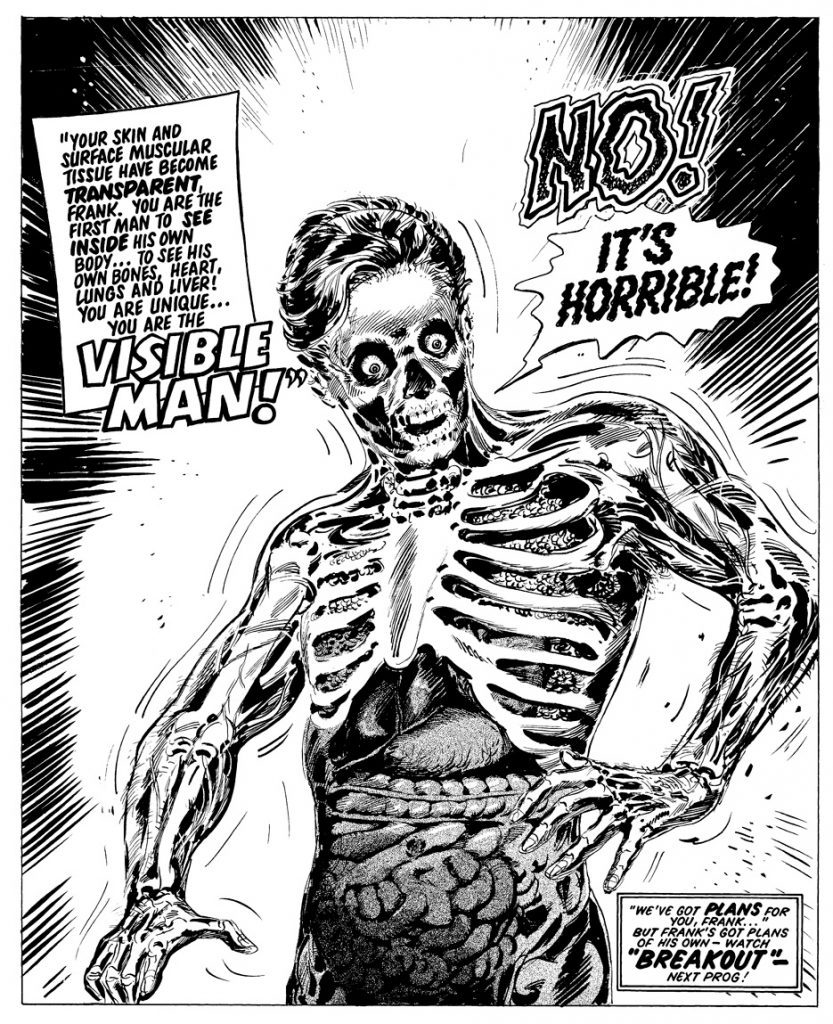
There’s the basic idea for Six Million Dollar Man clone Mach 1, the bones of a future sport story called Harlem Heroes, and some exciting ideas on time travelling dinosaur hunters appropriately called ‘Flesh’, though the rationale behind it still needs some working out. There’s another wonderfully entertaining piece, the Invisible Man in reverse, called The Visible Man, whose whole inner workings you can see through transparent skin. I love the idea – the art is gruesomely graphic – but for some reason as a story it never quite comes together in the way we hope it will, and it doesn’t make the final mix (I can see now the problem is that an invisible protagonist immediately conjures up several story avenues, while a visible one merely suggests a freak show).
Add to these a future war story about a ‘Volgan’ invasion of Britain and the revival of old-time Eagle hero Dan Dare, the first series of which Pat and I are to write together. Dare strikes us as irretrievably dated and we fear it won’t sit well with the rest of the material, but it seems to be a must from the point of view of publicising the new comic.
What is missing, I realise, is a cop story. I’d had it hammered home from my time editing Valiant with the success of One-Eyed Jack, the hard-nosed New York detective, how popular tough cop stories are – the tougher the better – and have had it in mind to go one step further from tough to positively brutal. Pat has created another story for the new comic about an occult detective. It’s one of the weaker stories he has devised and I feel it has little chance of making the final mix – indeed, I don’t think in the end the story is ever used – but the character’s name, the story’s title, is Judge Dread. (Or is it Dredd? Clearly not in my mind as yet, so perhaps that change comes later to avoid the reggae star’s lawyers coming down on us like the avenging fist of Jah.)
So I make the suggestion that we pinch the title to use for the cop story. Pat is very up for that, as it immediately suggests a new kind of future law – no longer just the police, but judge, jury and – if need be – executioner.
I write the first script while visiting my mother in her little council flat in Scotland. I’ve often wondered if there should be a blue plaque on the wall outside ground floor, 11 Maple Road: “The first Judge Dredd script was written here”. Come on, Greenock Council, get your finger out.
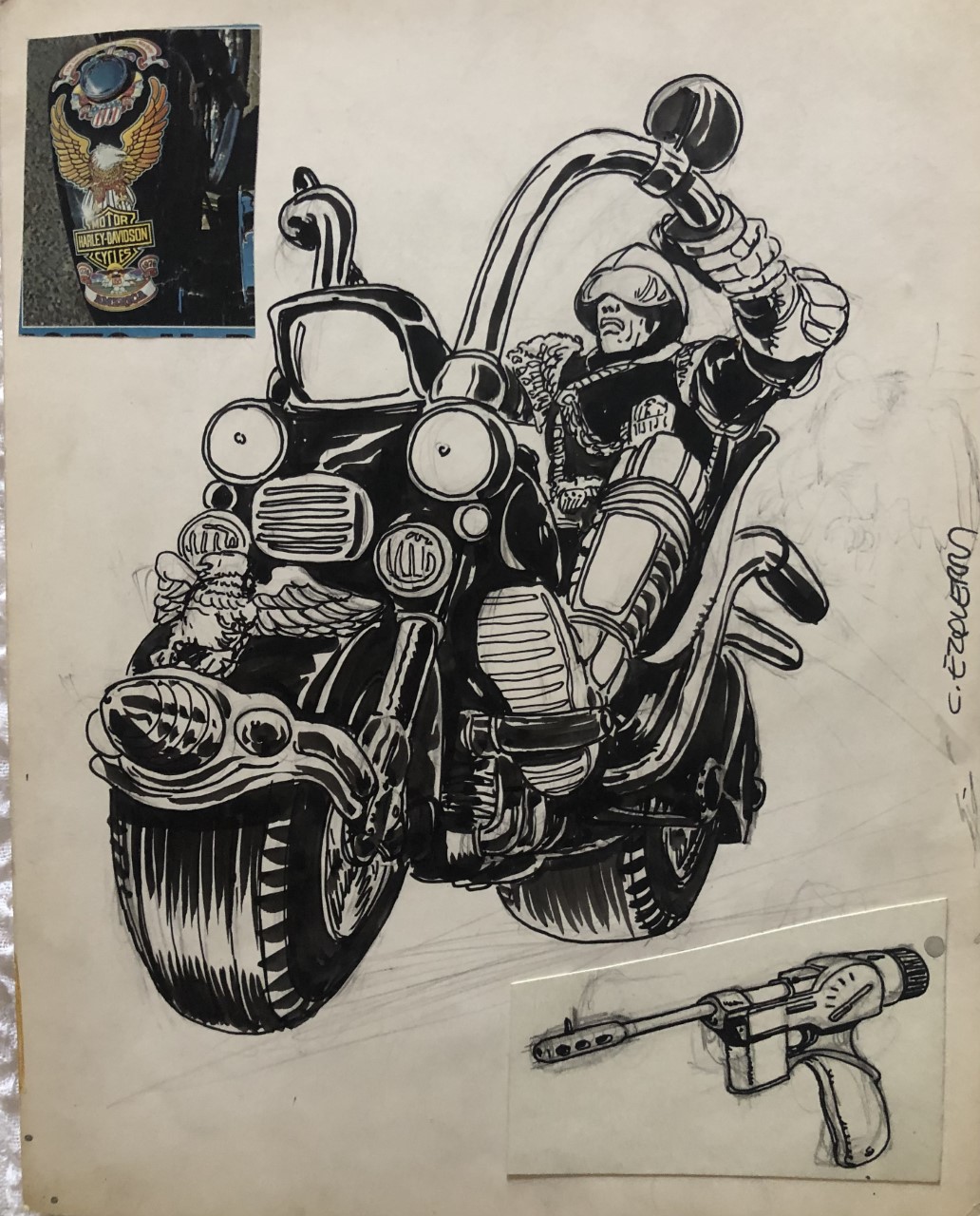
With the script I include a single reference, a grainy image cut from a newspaper of the film poster from Death Race 2000, showing David Carradine on a bike in black helmet and leathers. Very spare and not at all ornate.
When the art comes back from Carlos it looks nothing like the hero I had imagined. I absolutely hate it. “I’m not fucking writing that!” I mince no words. “He looks like a fucking Spanish pirate!”
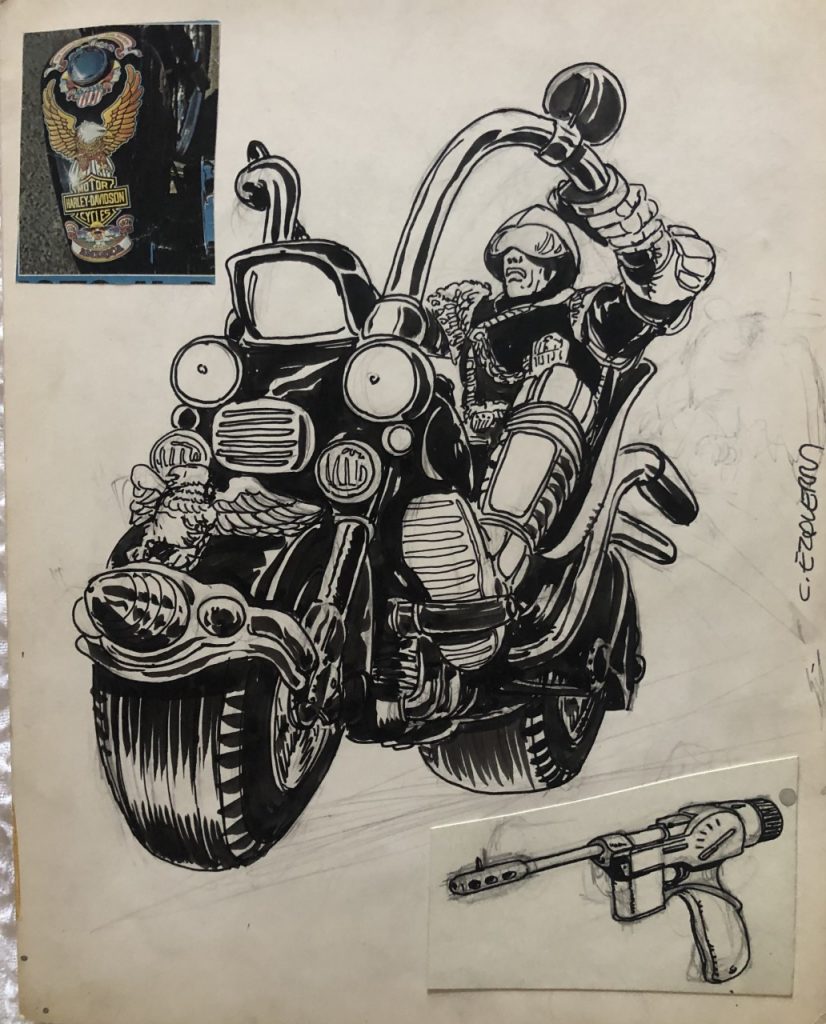
As usual, when it comes to any sort of artistic disagreement with Carlos, he is right and I am very wrong. As well as a good friend Carlos is – I’ve probably said this before – the best character creator I’ve ever had the pleasure and privilege of working with. In fact, I think I learn my lesson here and now with Dredd and never again dare to question his judgement.
My original script, however, is never used. When the story does eventually appear, in issue 2 of 2000AD, a number of changes have been made including, I imagine, the alteration of the name to Dredd. Dredd no longer appears for a section of the script in an actual courtroom (as I had written) before taking to the streets. The city – which I had simply referred to as future New York – is now, thanks to a suggestion from long-time Fleetway art man Doug Church, Mega-City One. Both of these changes are clear improvements. Though it makes no sense that actual courts would not exist in Dredd’s future it simplifies and streamlines the concept, and in comics that’s no bad thing.
I had also written the script with two levels of law enforcement – normal police alongside the judges. This too has disappeared. It makes no sense to me, as why train a judge for fifteen years to be the ultimate organ of justice and then send him out on traffic duty? But you work with what you’ve got.
Right at this moment, however, I personally am not working with anything, as I have quit 2000AD never, I believe, to return.
Somewhere during the creation process Pat had informed me that we would be allowed to produce the comic as a contract job – in other words, we would put it together independently and deliver it to the company complete, for an agreed price. This would allow us and other creators not only to receive credits for scripts and art, but to retain some level of copyright on the material. It will also allow us to extract a level of income not generally available to underpaid freelancers.
Shortly before launch date, however, the publisher lets it be known that this will not be the case. 2000AD (for the title has been decided upon by now) will be produced in house as usual, and fuck you. I utter a lot more of my own fucks to go with that one, and I’m off, turning my back on 2000AD forever…
…until issue 10. Yes, so resolute am I in my rejection of IPC duplicity that I hold out for a good few weeks. Never say I’m one to easily abandon a stand against the corporate enemy.
The fact is, as well as the work being interesting, the money is too good to ignore. In designing the comic Pat has made the decision to give much more prominence to the art. Gone are the standard 9-12 – sometimes as many as 16 or 18 – panels per page often seen in British anthology comics. Artists are to be given room to breathe, to fully express themselves, with fewer panels per page and frequent splash pages. This is achieved by in general doubling the page-length of stories without increasing the number of panels per episode. To maximise its visual appeal talented art man Doug Church is brought in to create exciting page layouts and to redesign pages that are considered not up to scratch. Many an artist is given ample cause to curse editorial when their art is returned for alterations – indeed, many a writer if their scripts are found not to give due consideration to the visual potential of their stories.
As an approach it works very well. 2000AD is a supremely exciting-looking creature and on launch immediately captures the imagination of its readership.
From a writer’s perspective the expansion of each story’s page count has the knock-on effect of doubling one’s income – a six page rate on average for what amounts to a three page story. I have no qualms about accepting this pleasant bonus. Pay rates in the industry have been gradually falling in rough correlation to comics’ diminishing circulations. We are merely regaining lost ground.
Of course there’s a trade-off. With fewer stories per issue, each one must be absolutely spot on. Scripts that don’t meet with editorial approval are not infrequently returned for reworking. There’s no room for passengers on the 2000AD gravy train.
The story I return on is the first Robot Wars saga, introducing the deranged android tyrant Call-Me-Kenneth and Dredd’s fawning robot servant Walter with the endearing (some would say highly irritating) speech defect. It’s the first multiple-length Dredd story and features Dredd’s shock resignation from Justice Department after the Chief Judge refuses to heed his warning about Call-Me-Kenneth – echoing, perhaps, the principled stand of a certain comic scripter…and of even shorter duration. Well, Dredd’s never one to abandon his city in its hour of need.
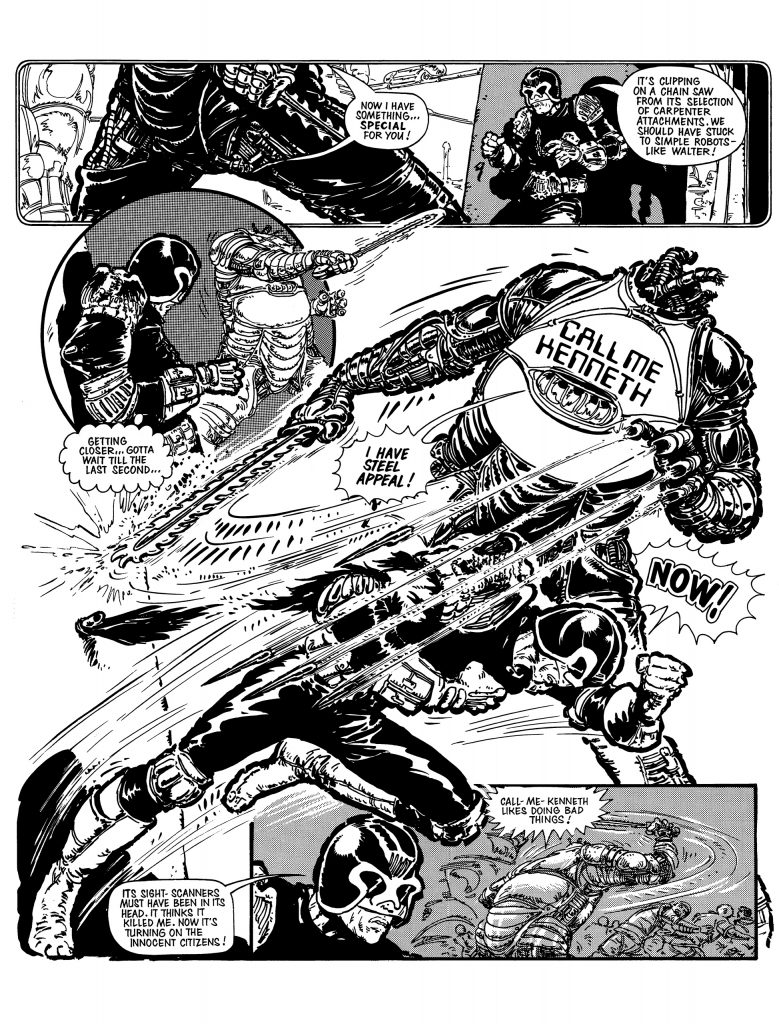
The story also sees, on episode 1, Carlos Ezquerra to art duties. Carlos has his own issues with the comic, to do with what he considers lack of proper respect for him, having found himself to some extent sidelined and other artists preferred while copying his brilliant creation.
His initial disaffection will forever colour his attitude to the good judge, and though he will over the years draw many a Judge Dredd saga, and do it brilliantly, Dredd will never be the character closest to his heart.
Apart from Carlos, in the early days Dredd will be drawn by a number of excellent artists, mostly British, and most notably by the trio of Brian Bolland, Ron Smith and Mick McMahon. Each in their own way will offer something different to the character: Bolland’s beautifully rendered, high-octane inks – McMahon’s incredibly imaginative, bordering on surreal, take on the character – Smith’s fluid, glossy professionalism.
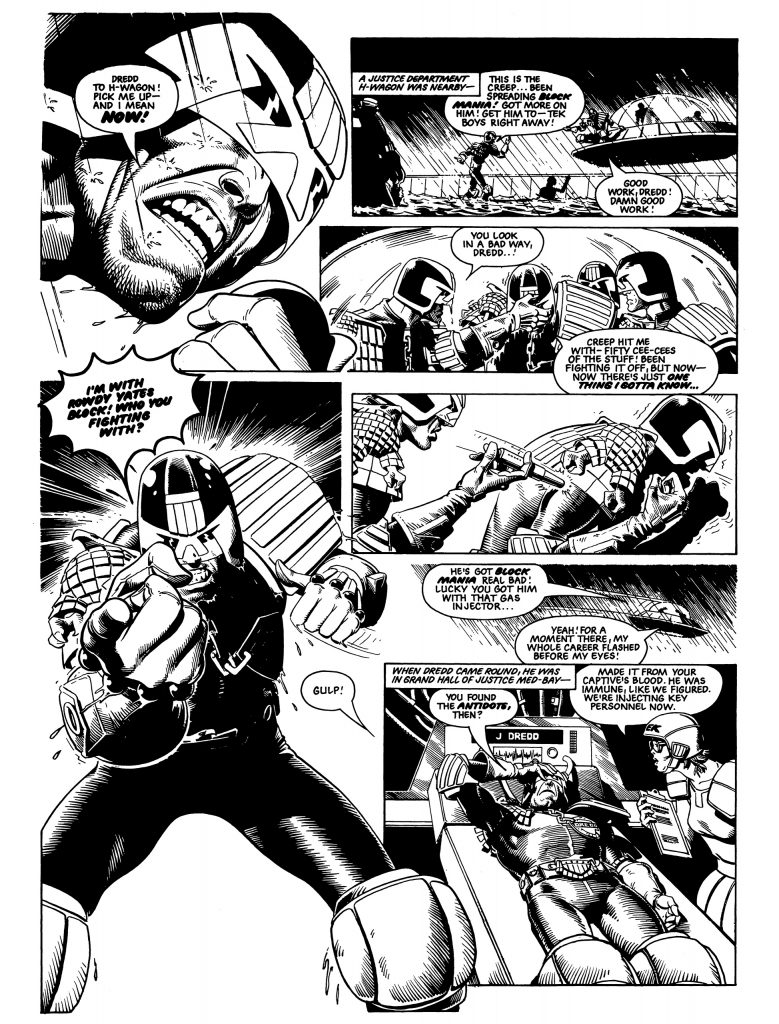
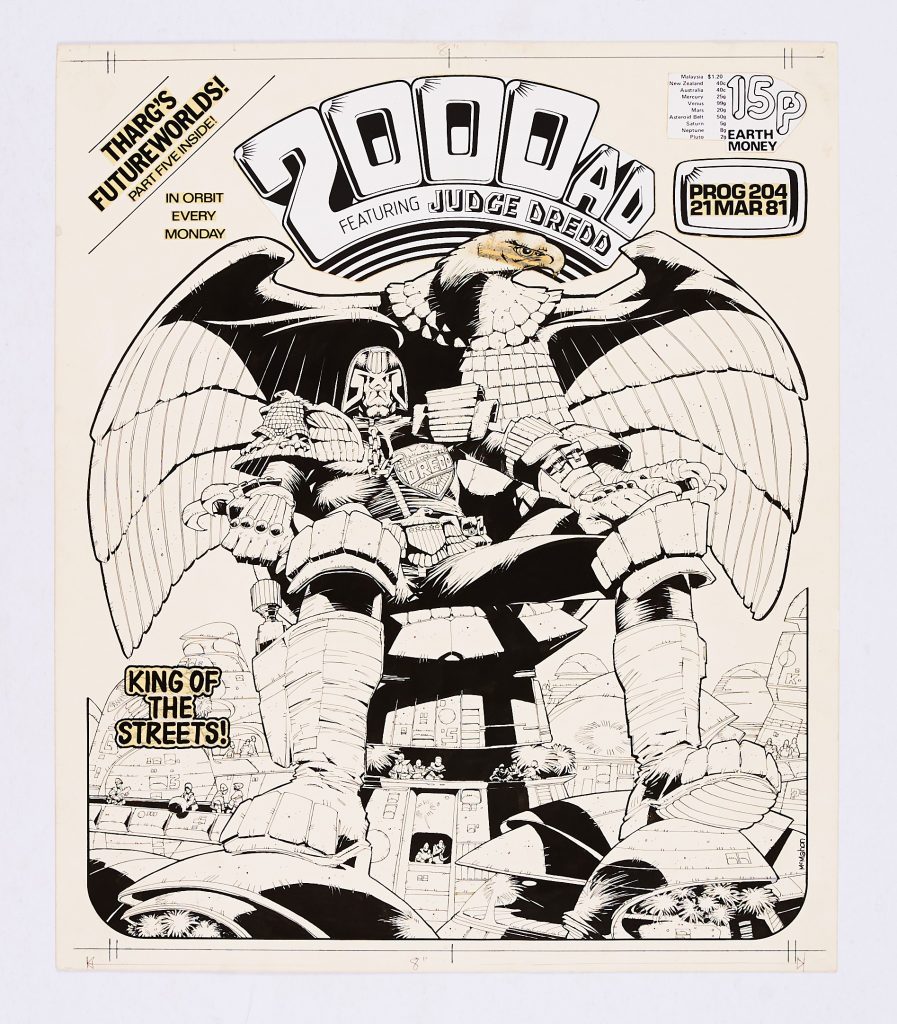
The early scripts on the other hand are a mixed bag – I don’t exclude my own from that description – offering a collection of mainly one-off efforts of differing quality. After the Robot War story, the series is wandering, searching for the elements that will lift it out of the ordinary, distinguish it as something special.
The next big boost will not happen until issue 61 with the appearance of Pat Mills’ major opus, the first true Judge Dredd epic, The Cursed Earth.
Back to part 7: AIEEEE DARKIE!
NEXT: Part 9: Life, Death and Starlord